Bear with me, reader, as I provide a vignette into raising multiple kids in the city of San Francisco. I’m out of milk, bread, and I need a dozen Topps Chrome basketball card packs as party favors for my third grader's birthday. I need the milk tonight, but the bread and basketball cards first thing in the morning. Tonight, I also need to cook my children dinner, assist (really focus) them on homework, and make sure they get to bed at a reasonable time. I have four options.
Just go without the items until tomorrow and accept nothing bad will truly occur
Drive to the mall, get the food and the basketball card party favors, but mess up homework and end up eating out
Amazon
Doordash
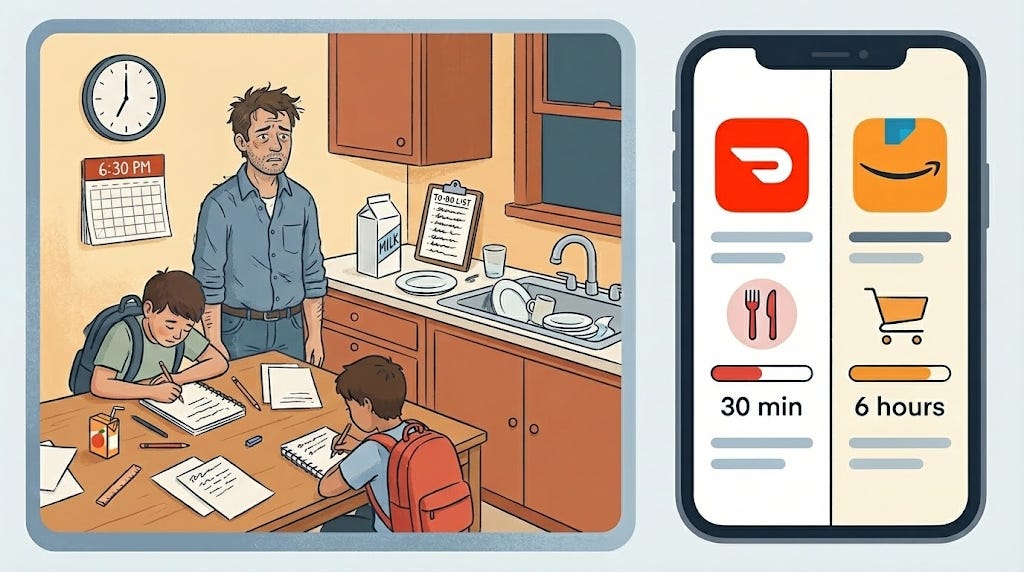
Understanding why DoorDash is even a consideration sheds light on the second wave of hyperfast, local eCommerce wars, and why DoorDash has a much better chance at succeeding; where companies like GoPuff (raised $5.2B to deliver items in ten minutes), Kroger (just wrote down $2.6B in warehouse robotics investments), and Shopify (acquired and exited logistics investments in two years) failed. First, Amazon.
Amazon’s Infrastructure Advantage
Amazon has1:
350+ fulfillment centers in the US
500+ Whole Foods stores in the US alone
Over 1,000 total logistics facilities worldwide
More than a million robots
40,000 semi trucks
30,000 delivery vans
110 aircraft2
Amazon is a logistics leviathan with a vast reach. It built a hub-and-spoke architecture with massive fulfillment centers (600,000 to 1 million square feet) that can store millions of products. It gets packages to the right region through sortation centers. And then delivery stations (60,000-200,000 square feet) stage packages for the final leg. Amazon makes use of Amazon Flex drivers and Delivery Service Partners for the last mile.
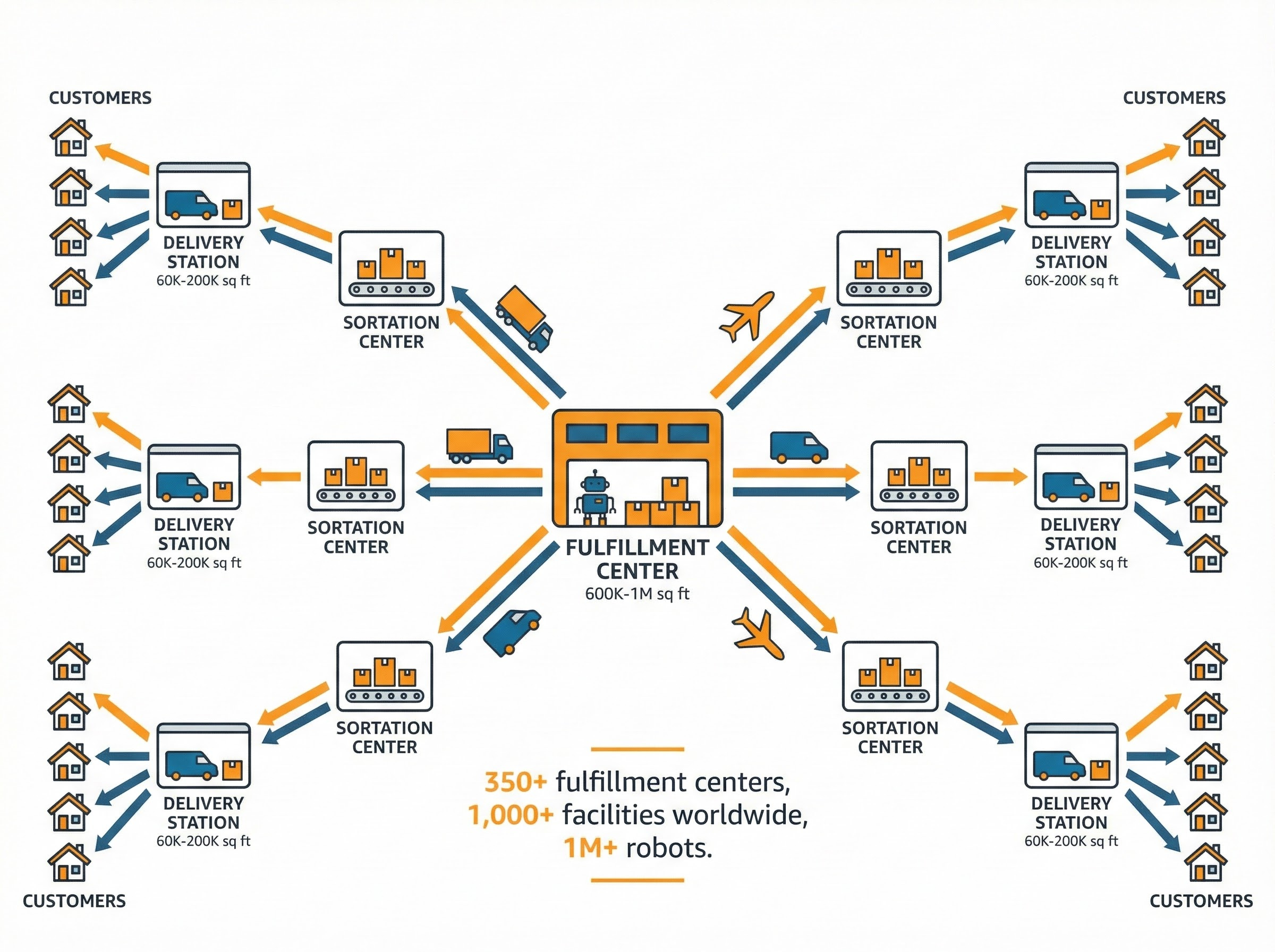
Not content with the variety of products available quickly, Amazon is closing older warehouses and building new “same-day” facilities closer to population centers. With a goal of getting to sub-same day delivery. Amazon is testing “sub-same-day” micro-fulfillment in Seattle. These are small dark stores that operate 24/7, with Flex drivers cycling through every few minutes.
Over 30 years and almost $200B in capital expenditures3, Amazon has built a formidable advantage. One that most retailers struggle to recreate.
In my particular case, while Amazon can deliver the grocery items within about 6 hours (thanks to the 4+ Whole Foods locations in San Francisco alone), the basketball cards would take 12 hours.
Both work.
However, the basketball card inventory on Amazon appears to be different than the in-store versions, and I’m not sure if it’s real. This leads me to consider DoorDash.
DoorDash’s Speed Advantage
DoorDash, the restaurant food delivery service, can get me grocery items through DashMart in under 30 minutes and physical goods, from a retailer, in about an hour. Physical goods on DoorDash are typically the same, or slightly cheaper, in price than Amazon. This cost advantage can, however, be offset by fees and tips. It’s faster, but with a convenience tax, added on.
During the pandemic, DoorDash started rolling out DashMarts. A typical DashMart employs 15-20 W-2 workers, with 4-6 on site at any time. Many operate 24/7. Product turns over daily with regular vendor deliveries. Orders are packed for delivery in under 30 minutes.
This is not an Amazon fulfillment center.
There are no miles of conveyor belts, no armies of orange Kiva robots. The DashMarts are small. More convenience store than a warehouse, and instead contains around 2,000 SKUs. Today, there are over 100+ DashMart locations. While DashMart fulfillment centers started out serving just DoorDash, they recently announced a change.
In September 2025, DoorDash announced they were opening their network of 100+ warehouses to retailers as DashMart Fulfillment Service4. This is different from the traditional retail offering through DoorDash.
DashMart Fulfillment Services lets any retailer store inventory in DoorDash’s warehouses. DoorDash handles everything: receiving inventory, managing stock levels, picking orders, packing boxes, delivering to customers. The retailer just sends products and collects revenue. This solves some of the inventory data quality issues (what’s actually in stock) and speed issues that retail items from DoorDash currently face.
But, what stands out is how Amazon and DoorDash’s approaches contrast with others that have tried and failed.
Quick Lessons in Failed Logistics Buildouts
Shopify, Kroger, and a host of quick commerce startups have a few lessons worth pointing out. All of these companies attempted to build out logistics networks, in-house, that could compete with Amazon.
Shopify’s lesson: Focus
Logistics wasn’t Shopify’s core business. Their advantage was software: payments, storefronts, marketing tools, app ecosystem. That’s where Shopify had real expertise and competitive advantage. When Shopify tried to build logistics, they were competing against Amazon with 1% of the resources while simultaneously neglecting the software business that actually differentiated them. After two years, and a failed acquisition5, Shopify exited the market.
Kroger’s lesson: Geography
Kroger’s error was different from Shopify’s. They picked the wrong technology for their market. Kroger went with a partner that built fantastic automated storage, automated retrieval system that was tested and proven in the UK.
Ocado works in the UK, where population density supports centralized fulfillment. A single facility can serve millions of people within a reasonable delivery radius.
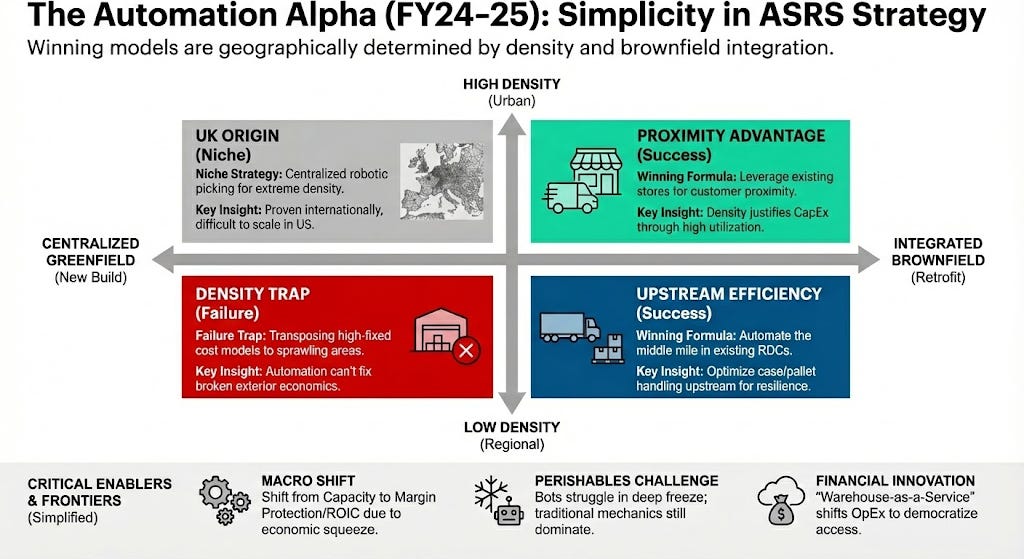
American geography is different. Outside a few dense metros, customers are spread across vast distances. A 500,000 square foot CFC in the Midwest might have a delivery radius that includes more cornfields than customers.
After a couple of years of partnering with Ocado, Kroger realized the error of its ways. Kroger wrote down $2.6B6 in Ocado investments, and then announced a partnership with DoorDash.
The $10B in failed instant delivery startups
During the pandemic, there were a cohort of startups offering incredibly fast deliveries for everyday items. Startups here include: Buyk, Fridge No More, 1520, Jokr (exited US and Europe), Cajoo, Dija, Gorillas (acquired in distress), Getir (retreated to Turkey after losing billions), Flink (retreated to Germany and Netherlands). And, in the US, Gopuff7 (once valued at $15B, now half of that).
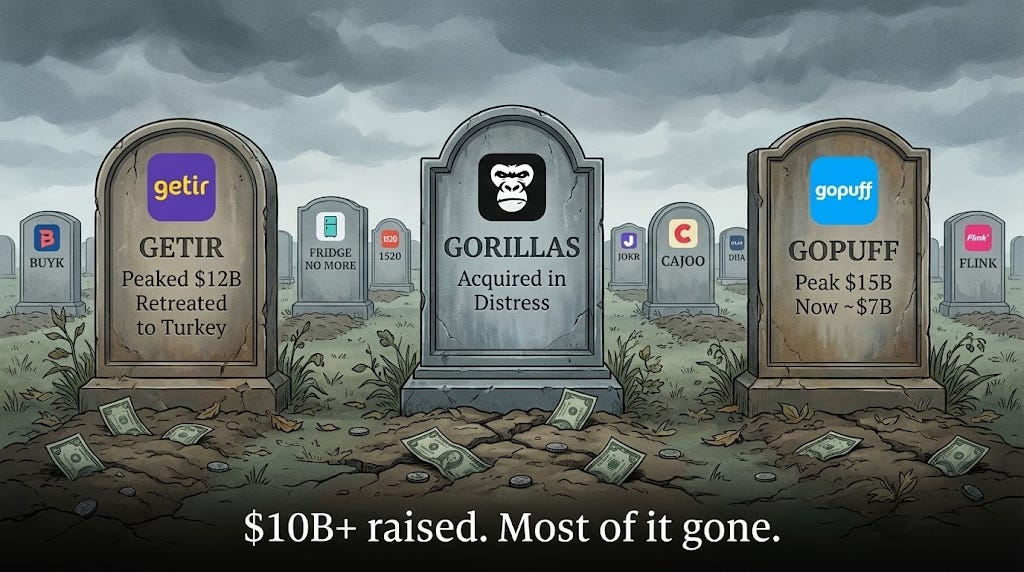
These companies raised over $10 billion collectively during covid. Most of it is gone. Here are the key lessons from these efforts.
The unit economics were brutal. Traditional grocers operate at 1-3% net margins. Quick commerce startups promising 10-15 minute delivery needed to operate their own warehouses, employ their own pickers, and pay their own couriers
Customer acquisition was insanely expensive. Building delivery infrastructure is one thing. Getting customers to use it is another. Industry estimates put customer acquisition costs for quick commerce at €70-100 per customer8. And customers were happy to chase discounts across apps, with minimal switching costs. When the subsidies stopped, many customers went back to the grocery store.
By 2024, Getir had exited the US, UK, Germany, and Netherlands entirely—retreating to Turkey. The company that had acquired Gorillas, Blok, Weezy, and other competitors in a bid to dominate Europe ended up surrendering every market it had conquered. Gopuff, which pioneered the category in 2013, is still standing—but smaller, humbler, and still trying to prove the model works at scale.
Learnings: ultrafast delivery is possible. Profitable ultrafast delivery is harder.
Why DoorDash Can Succeed
DoorDash is avoiding the issues faced by the companies above. Whether it’s logistics as a core focus of its business (Shopify), favorable geography (Kroger), or having already solved a number of issues facing the previous wave of quick commerce startups.
DoorDash had existing demand before building infrastructure. Gorillas, Getir, and Gopuff had to acquire customers from scratch. DoorDash already had millions of active customers ordering food. DashMarts are an upsell to an existing user base, not a new customer acquisition problem.
DoorDash uses gig workers, not hourly employees. Getir paid couriers hourly wages, which meant paying for idle time between orders. Gopuff similarly employs drivers. DoorDash’s Dashers are 1099 gig workers who only get paid when they’re delivering. The cost structure is different. DoorDash can flex labor up and down as demand changes.
DoorDash promises reasonable speed. The 10-minute promise killed European quick commerce. DoorDash promises 30 minutes or “under an hour” from DashMarts. Fast enough to be convenient, slow enough to be operationally sane.
DoorDash is a platform, not a retailer. Gopuff owns all its inventory and runs all its warehouses. DoorDash is opening DashMart Fulfillment Services to other retailers. CVS, Kroger, Party City, and others have signed up. This means they can aggregate volume from multiple brands across their infrastructure, spreading fixed costs across more revenue streams.
DoorDash versus Amazon
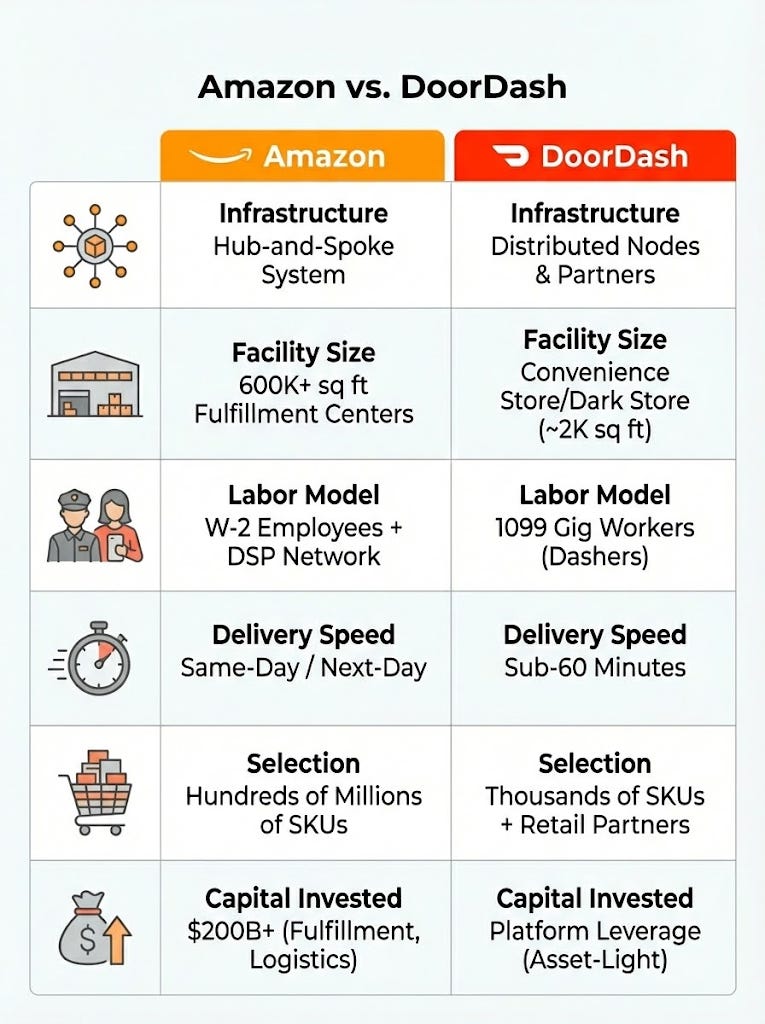
Amazon built massive regional warehouses and pushed products outward through a hub-and-spoke network. The fulfillment centers are far from customers; speed comes from sophisticated logistics moving packages through sortation centers and delivery stations.
DoorDash built small warehouses close to customers. There’s no hub-and-spoke, instead there are lots of nodes, each serving its immediate neighborhood; speed comes from proximity. If the DashMart is 10 minutes away, delivery takes 10 minutes plus picking time.
DoorDash isn’t competing against Amazon as an “everything store”; DoorDash has its selection of convenience store SKUs and access to the prevailing retailers. This compares to hundreds of millions of products from Amazon; however, DoorDash has convenience measured in half hour increments.
Physical infrastructure is one difference, but the labor model is another.
Amazon’s fulfillment centers employ hundreds of thousands of W-2 workers. Even their last-mile delivery, technically handled by “independent” Delivery Service Partners, involves significant fixed costs and ongoing relationships.
DoorDash’s delivery network is 1099 gig workers who turn on the app when they want to work. Labor costs are variable, not fixed. If demand spikes, more drivers come online. If demand drops, DoorDash doesn’t pay for idle capacity.
This makes DoorDash’s model more flexible but also more dependent on a steady supply of people willing to do gig work. It’s a different bet on how labor markets will evolve.
What to Watch
The Amazon/DoorDash battle will play out over the next several years. Key questions:
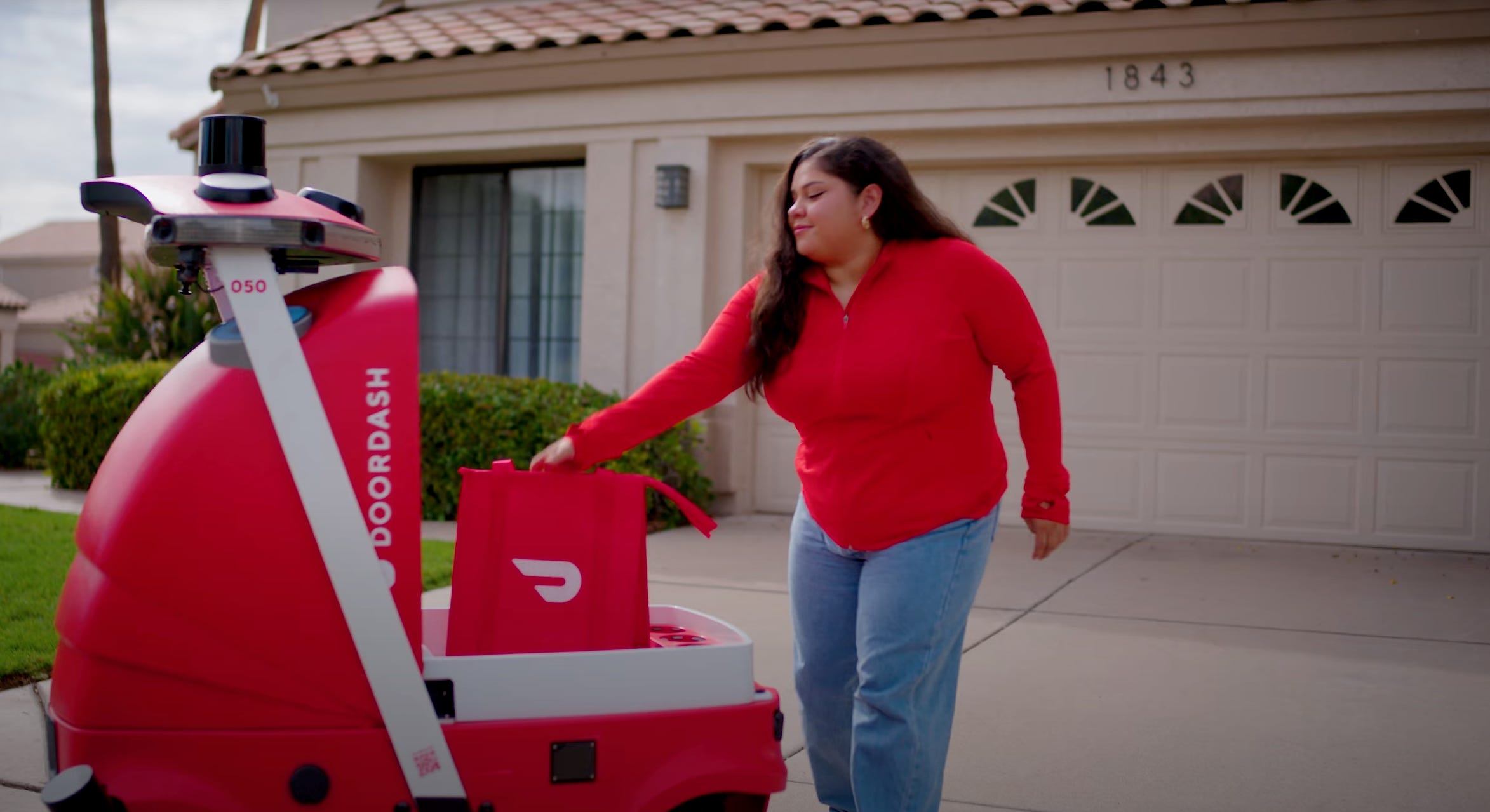
Who wins last mile robotics? Both Amazon and DoorDash are innovating in last mile logistics delivery solutions. Both are experimenting with drone delivery options, and DoorDash has been exploring an autonomous, ground-based delivery vehicle.
Can DoorDash’s model scale? 100+ DashMarts is a start, but Amazon has 1,000+ facilities. DoorDash needs to keep expanding while maintaining the unit economics that make the distributed model work. The fact that Kroger, CVS, and Party City have already signed up suggests the platform model has legs, but Gopuff has 500+ warehouses and still isn’t profitable. Scale alone doesn’t solve unit economics.
Will Amazon respond by going smaller? Their Seattle “sub-same-day” test and UAE micro-fulfillment suggest they see the threat. Amazon has the resources to build thousands of small facilities if they decide to. The question is whether their organizational DNA optimized for massive scale can adapt to a distributed, node-based architecture.
How do local businesses and politicians respond? Politicians in San Francisco recently passed a resolution making it difficult for DoorDash to test out drone delivery services, limiting options for future delivery. Anti-tech and anti-big business coalitions would be happy to ban automation from larger companies and retailers.
For now, the battle lines are drawn. Amazon is the everything store that keeps getting faster. DoorDash is the right-now store that keeps getting bigger.
In my case, I ended up using DashMart and DoubleDashing (doing two different retailers in one DoorDash order) for the items I needed. The immediacy of DoorDash and greater comfort with the specific retailer selling the basketball cards pulled me towards DoorDash.

Milk, bread, and cards arrived; homework was done; and dinner was eaten.
https://redstagfulfillment.com/how-many-amazon-warehouses-are-there/
https://capitaloneshopping.com/research/amazon-logistics-statistics/
https://www.financecharts.com/stocks/AMZN/cash-flow/capital-expenditures
https://www.pymnts.com/news/delivery/2025/doordash-offers-retailers-fulfillment-services-from-dashmart-locations/
https://www.fool.com/investing/2023/05/04/why-shopify-stock-roared-higher-on-thursday/
https://www.bloomberg.com/news/articles/2025-11-18/kroger-to-close-delivery-centers-record-2-6-billion-impairment
https://en.wikipedia.org/wiki/Gopuff
https://sifted.eu/articles/grocery-delivery-getir-europe