3 straight years of revenue declines for publicly traded staffing companies, but CEOs claim AI isn’t to blame. Instead, they point to economic and policy uncertainty. Randstad, Robert Half, ManpowerGroup, and ASGN reported earnings over the past several weeks, and the message was remarkably consistent across all four:
Permanent hiring is down
Temporary hiring is soft
Even outplacement services (helping recently laid-off workers find new jobs) are struggling
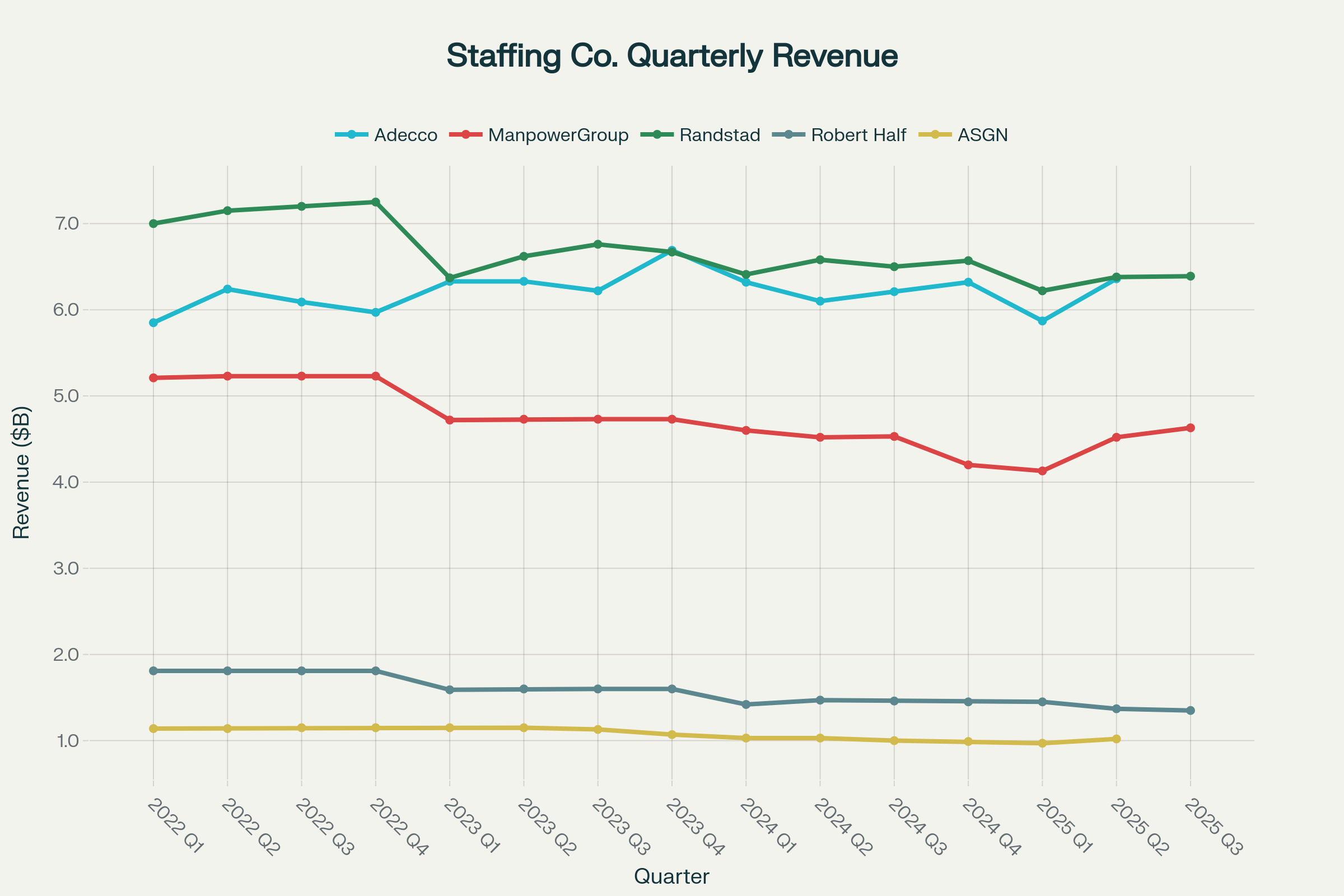
These companies say uncertainty is to blame for the frozen labor market, not technology. Robert Half’s CEO was emphatic, stating
I feel about as confident as I feel with anything that AI has not contributed to what has happened so far, so far, either for the industry or for Robert Half.
Contrast those reasons with headlines from major purveyors of Gen AI.
AI could wipe out half of all entry-level white-collar jobs — and spike unemployment to 10-20% in the next one to five years — Dario Amodei, Anthropic CEO
Gen AI will transform everything, no one will have jobs, and they are laying off thousands of workers. Amazon announced 14,000 corporate layoffs the same week AWS reported 20% growth and raised capital expenditure guidance to $125 billion.
Both narratives are self-serving.
For hyperscalers, claiming that Gen AI is so good they can layoff their staff is a sales tactic. Staffing firms, on the other hand, that admitted their businesses were being eaten by AI would see their stock prices tumble. Just see Chegg for how investors respond.

Both narratives are self-serving, but both narratives have elements of truth.
Gen AI technology is diffusing through the market. It starts with early adopters, who are working through the best ways to implement AI. We can get a fuller picture by looking at past instances of AI adoption and automation, as well as roles that won’t be impacted by AI.
Historically, when manufacturers implement AI, those companies experienced, “a measurable but temporary decline in performance followed by stronger growth.” Productivity within the organization looks like a “J-curve”.
To truly adopt and make use of AI, companies need to rework workflows. Companies are trying to figure out:
how to adopt AI
which AI systems to adopt
how much of a difference AI will make in their business
how many people they will need, where
Companies are not sure how many people they need. The old models tying the number of workers to customer service calls, sales accounts managed, product managers to developers are breaking. The new ones have yet to be discovered. Rationally, companies are holding off on hiring until they figure this out.
Looking at where the US economy has added jobs since the release of ChatGPT helps show this:
Growing Sectors (Jan 2023 → Jan 2025):
Healthcare & Social Assistance: +2.1 million jobs (+8.5%)
Government: +1.1 million jobs (+4.9%)
Leisure & Hospitality: +611,000 jobs (+3.7%)
Declining Sectors (same period):
Professional & Business Services: -219,000 jobs (-0.96%)
Information Technology: -122,000 jobs (-4.0%)
Going deeper into staffing, this shows up, too. Across all four companies, operational and temporary hiring held steady or even grew, while professional and IT hiring collapsed:
ManpowerGroup: Manpower brand (operational/temp) grew 3%, while Experis brand (professional/IT) declined 7%
Randstad: Operational business returned to flat/slight growth, while professional hiring declined 8-18% across various markets
Robert Half: U.S. Talent Solutions revenue declined 11% year-over-year, with overall revenue down 8%
ASGN: Assignment revenues (placing workers) fell 13.2%, while consulting revenues (building AI systems) grew 17.5%
Until companies figure out the types of knowledge workers they need to hire, in what quantity, this particular knowledge work segment will remain “frozen”. We are experiencing an expensive transition period where:
Hyperscalers are spending hundreds of billions on AI infrastructure
Knowledge work staffing companies’ revenue suffers because companies aren’t sure how to hire
Consultants boom as they help companies figure out how to adopt and adapt to AI
Workers stay at companies going through re-org after re-org or they might exit the labor market entirely
We will eventually get through this transition phase, but, for the staffing companies and workers on the sideline, it’ll take too long.