Public company staffing firms are starting to see a return to year-over-year growth, and while some of this is simply lapping poor comparable numbers, the underlying drivers of growth could be telling us about Gen AI’s impact on the labor market. The growth drivers are in high complexity, high experience, knowledge work positions or in low complexity, physical jobs. What’s lagging is permanent placement, knowledge work environments. When paired with results from Upwork and studies on AI’s impact on the freelance market, this could be early signs of Gen AI’s impact on the labor market as a General Purpose technology.
Famous people in finance started at the bottom
In 1891, a fourteen-year-old boy named Jesse Livermore (the inspiration for the 1923 book, ‘Reminiscences of a Stock Operator’), walked into the Boston offices of Paine Webber and got a job as a board boy. A job that entailed standing on a narrow catwalk and scribbling stock prices on the chalkboard as the ticker tape spit out numbers.
The job requirements were minimal. Basic literacy, physical endurance, and showing up. An entry level position that got him involved in the stock market (Jesse eventually became one of the most successful speculators in American history, that just needed his foot in the door).

Electronic displays and computerized trading systems eliminated these types of jobs. This also had the effect of pushing up the requirements for an entry level job in finance.
This is what General Purpose Technologies do.
The General Purpose Technology general pattern
Economists use “General Purpose Technology” (GPT) to describe innovations so fundamental that they reshape entire economies rather than single industries. Electricity. The internal combustion engine. Computing. The internet. Each one follows a similar pattern:
Initial displacement: The GPT eliminates jobs that involve routine application of the capability it provides
Hallowing Out: Employment grows at the top (people who design, manage, and extend the GPT) and the bottom (physical and service work the GPT can’t touch), while the middle hollows out
Getting into a job takes more time: The low skill, entry-level jobs that used to train people for middle-skill work disappear, forcing a new pathway into jobs.
The board boy job that gave Livermore access to the market is an example of a position that was replaced by technology. The job existed because humans were the only technology capable of reading ticker tape and writing numbers on a board. Once a better technology existed for that task, the job vanished—and with it, the on-ramp that let a 14-year-old with no credentials learn the market.
AI as the Latest GPT
We may be watching the same pattern play out Generative AI. And the November-December 2025 staffing earnings just gave us real-time data on where the hollowing is happening. These earnings provide insights into demand for different types of labor in real-time, broken down by skill level and function. When hiring patterns shift, these earnings can help confirm it.
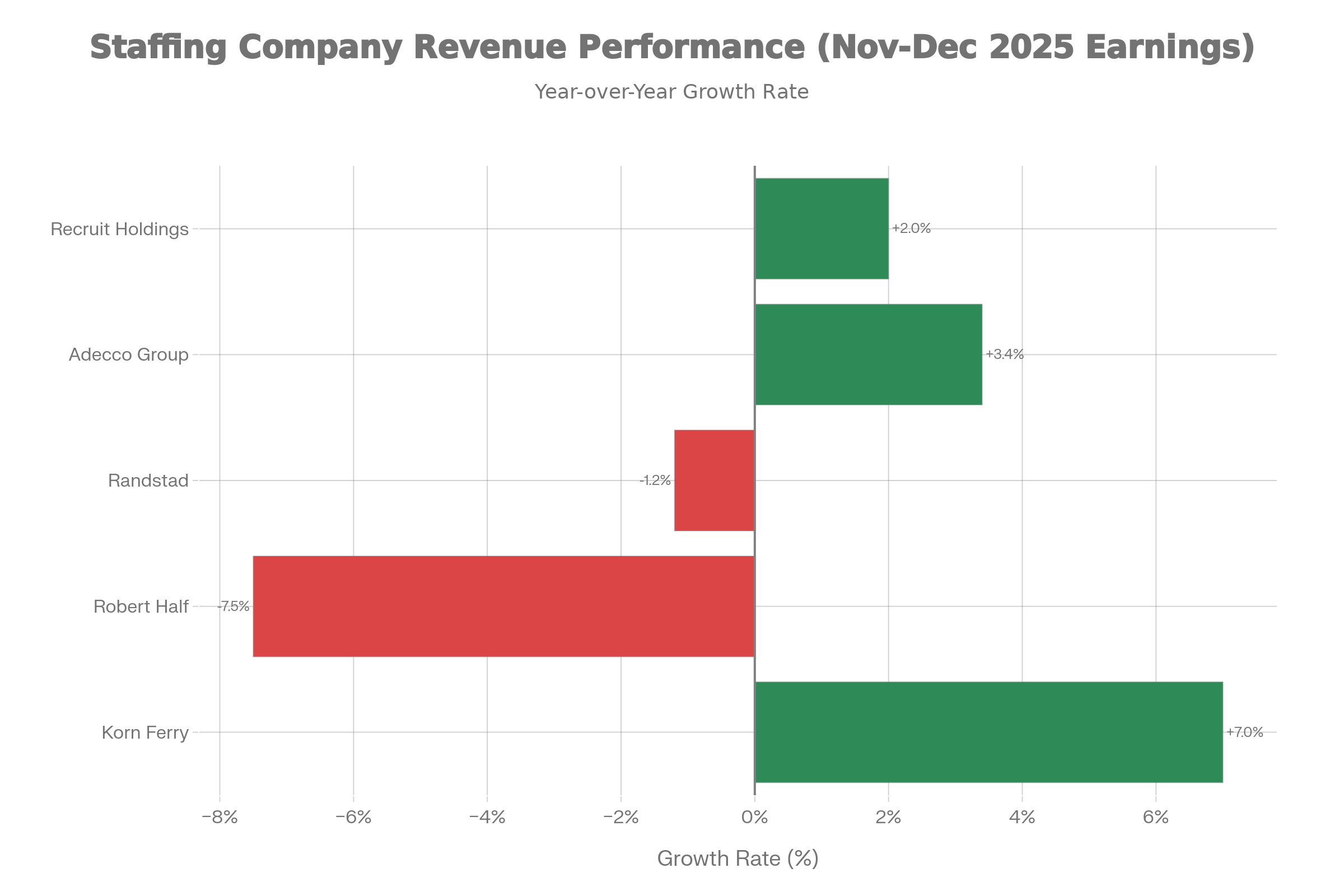
Here’s what the latest earnings show:
Growing:
Korn Ferry Executive, Professional, and Interim search: C-suite placements are booming. New assignments up 4% to 1,633, while interim position searches for fractional leadership roles are growing even faster.
Adecco Americas: +20% year-over-year at the regional level, driven by flexible staffing across all client segments. Physical work—warehouse, logistics, manufacturing—remains in demand.
Collapsing:
Robert Half Finance & Accounting: Down 9.9% as reported, 10.7% adjusted. Exiting September with revenues down 10% year-over-year. This is bookkeeping, financial report drafting, routine analysis—process-driven cognitive work with established patterns.
Robert Half Administrative: Down 11.1% as reported, 12.1% adjusted. Correspondence, scheduling, document management. Classic middle-skill office work.
Permanent Placement (across the industry): Randstad called out “low hiring confidence” and clients favoring flexibility.
The categories driving revenue growth are important
The GPT pattern predicts exactly this distribution.
They can process routine correspondence. They can handle administrative coordination, summarize documents, generate boilerplate. This is why the Robert Half F&A down 10% and Administrative down 11% numbers are important.
No one is going to outsource corporate executive positions to AI, and Korn Ferry Executive Search up 10%.
We haven’t hit embodied AI, yet, and the need for people to move items and do physical work is still important. Adecco Americas up 20%.
However, we still need work to get done by people.
AI has its limits, lots of them
The Remote Labor Index, a new benchmark from Scale AI and the Center for AI Safety, tested frontier AI agents on 240 real freelance projects worth $140,000 across 23 job categories. The projects span from game development, product design, architecture, data analysis, and video animation. Median project takes 11.5 hours for a human professional. Big caveat, the most recent numbers are from the previous generation of models (Claude 4, Gemini 2.5, ChatGPT 5).
Out of 240 projects, AI could deliver only about 6 at human-quality or better. The majority were rejected for being incomplete, technically broken, or professionally unacceptable.
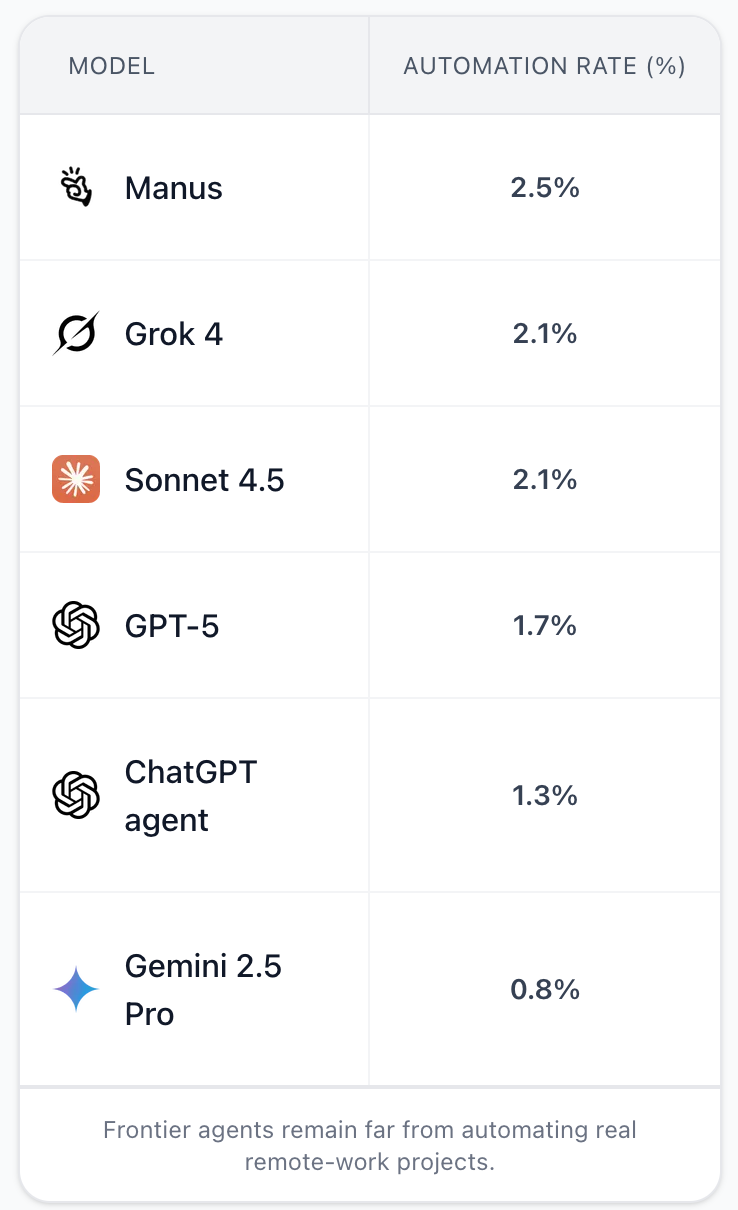
AI succeeded on simple generative tasks: images, audio, or prototype code, but failed when jobs were long, complex, and multi-step. AI is not about to autonomously replace professionals on complex tasks. But, AI doesn’t need to complete entire projects autonomously to impact certain job categories. It just needs to:
Convince corporations they don’t need to expand hiring
Augment enough tasks in routine work that demand for dedicated roles declines
Shift the complexity threshold upward, eliminating the simpler tasks that used to be training ground
The board boy job wasn’t eliminated because machines could do everything a trader does. It was eliminated because machines could do the specific thing board boys did—transcribe prices. That was enough to remove the rung from the ladder.
The finance, entry-level ladder’s evolution
This brings us back to Livermore. His path from board boy to subject of a book represented a model that defined career entry for over a century: start at the bottom, learn by proximity, move up if you’re talented and lucky.
Each GPT wave has systematically raised the barrier to that first rung:
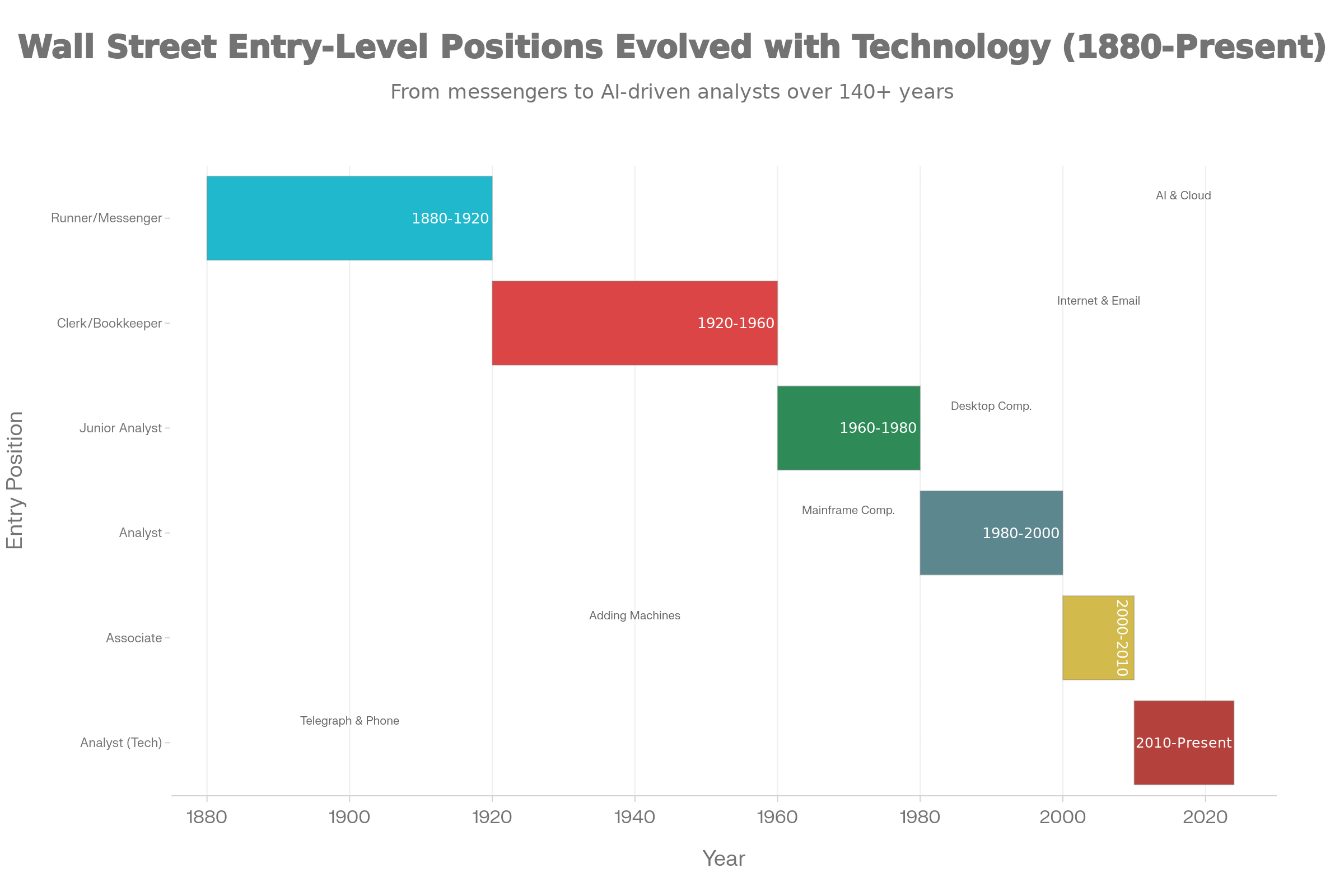
LinkedIn’s chief economic opportunity officer warned in 2025 that AI is “breaking the bottom rung of the career ladder” by eliminating the tasks that traditionally helped new graduates gain experience. A 2025 analysis found that 35% of “entry-level” positions now require years of prior experience.
The fundamental transformation isn’t just technological, it’s epistemological. In 1891, you learned finance by doing finance in close proximity to experts. By 2025, you must prove you can already do finance before anyone will let you try. This pattern will only continue, and apply to more categories of work.
The entry-level jobs that used to be training ground are precisely the jobs that GPTs eliminate first because they’re routine enough to automate, but valuable enough to be worth automating.
From a startup and investing perspective, the staffing opportunity lies in more complex work (heck, maybe even Forward Deployed Engineers) or in the physical labor and retail. The simple tasks, admin work, and entry level positions are going to be tough slogs.