Japanese corporate governance reforms designed to prop up the Japanese equity market are resulting in a worse, more expensive hiring market in the US. Japanese corporate reforms started in 2014 encouraged Japanese companies to improve return on equity, retain a lower percentage of earnings, return more cash to shareholders, and loosen the reins on activist investors.

The largest job site in the world (and US), Indeed.com1, is owned by a Japanese conglomerate, Recruit Holdings. Indeed (the HR technology business unit) is the largest source of profits for Recruit holdings, making up almost 2/3s of Recruit’s Profits2. After these reforms were enacted, and an activist investor took hold, Recruit tripled its buybacks.
To finance the buybacks, Recruit has raised prices on employers and slashed employment at Indeed by 1/3, raising EBITDA margins from 32% to a forecast 35.8%. The move broadcast by Recruit clearly shows it will raise prices and reduce the amount of free, unpaid jobs that end up on its site (in the US).
This means more expensive hiring costs for US employers (when demand for hiring is down), and fewer visible jobs for job seekers.
Healthy online ad businesses have falling prices and rising traffic
Online advertising businesses have slightly paradoxical metrics. As user traffic grows, prices will fall. More inventory chasing fewer eyeballs means less competitive auctions, lower cost-per-click, cheaper ads. A healthy online advertising business is one with growing traffic and falling prices. This is how Google works, how Meta works, how every auction-based ad system works.
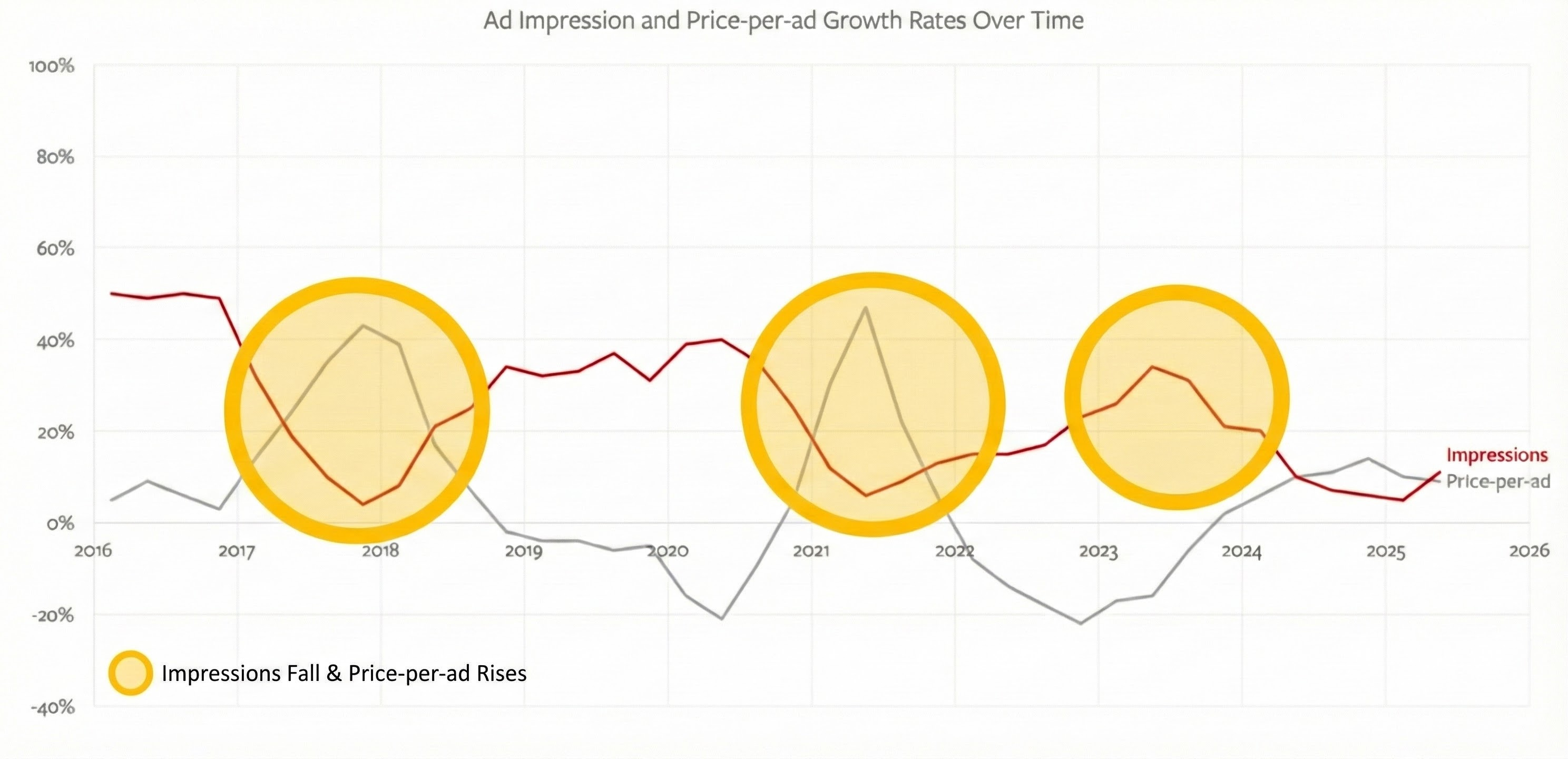
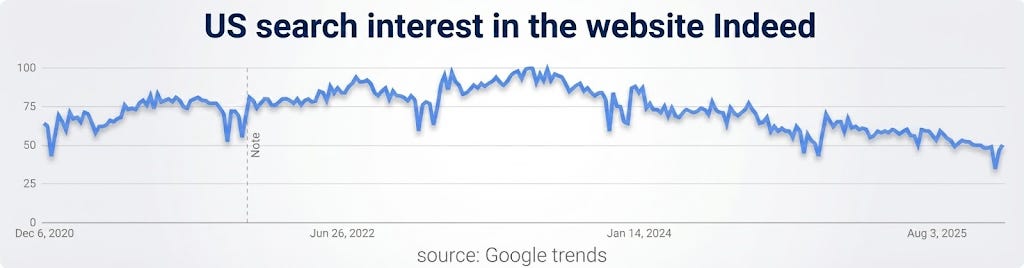
Indeed.com is experiencing the opposite: falling traffic and higher prices. While a weak labor market might increase a job board’s traffic (like has happened with ZipRecruiter and LinkedIn), Indeed’s traffic (and market share) may have peaked in 20223. Job seeker traffic isn’t the only decline, the number of employers has declined as well. This decline in revenue prompted Recruit ownership to increase prices. This means Indeed has falling traffic and rising prices.
To understand why the world’s largest job site is raising prices during the middle of a hiring recession, you have to look 6,000 miles away, to a boardroom and capital allocation reform movement in Tokyo that was enacted over a decade ago.
The mission to raise Japanese equity prices
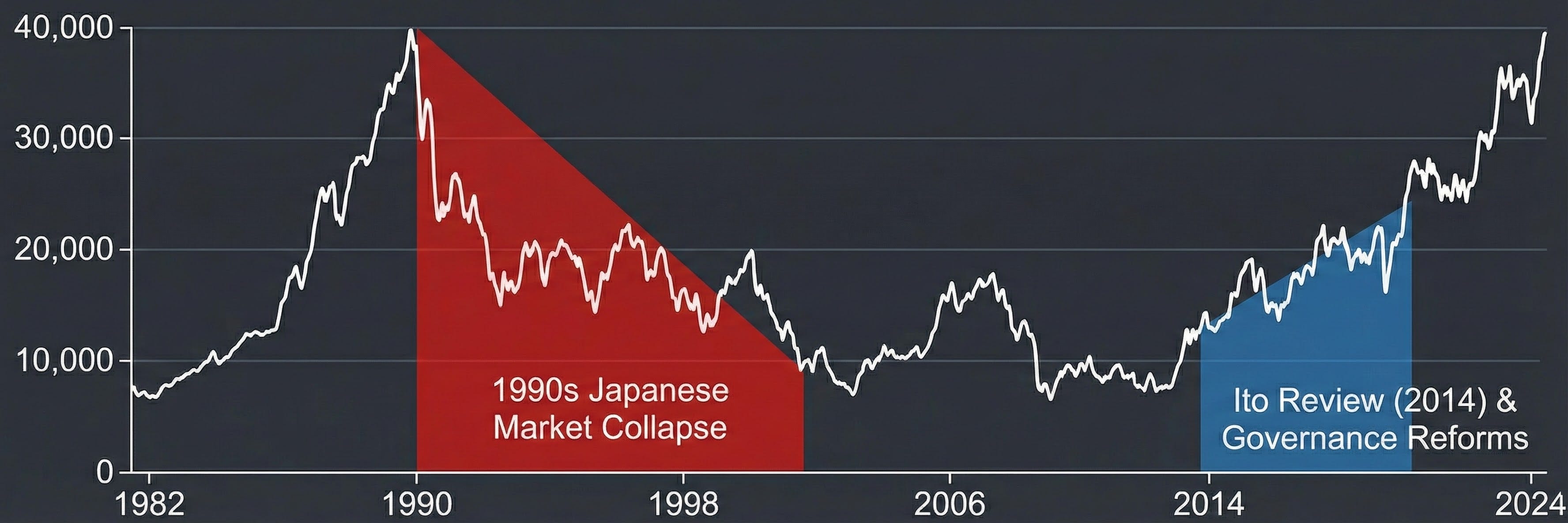
The Ito Review4, published in August 2014, established an 8% return on equity (ROE) threshold as the minimum for companies seeking global investor recognition. At the time, the median Japanese company ROE was 5%—worse than their estimated 7% cost of capital, meaning they were actually destroying value. Less than half of Japanese companies cleared the 8% bar, compared to 78% of S&P 500 firms (numbers from the Ito Review).
Japan’s Stewardship Code arrived the same year, requiring institutional investors to actually vote their shares and monitor companies. The Corporate Governance Code followed in 2015, mandating independent directors and forcing companies to justify those cozy cross-shareholdings. By 2021, Prime Market listings required one-third board independence. In March 2023, the Tokyo Stock Exchange directly targeted companies trading below book value with a blunt message: improve your returns or explain yourself. All of this also opened up the door for activist investors, which could frame their investments as helping companies to comply with the corporate governance changes.
Japanese companies responded. Buybacks exploded from essentially nothing to ¥18 trillion ($120 billion) in 2024, nearly doubling from the prior year. Total shareholder returns hit ¥25 trillion ($167 billion). Payout ratios jumped from 57% to 67% in a single year. Shareholder support for executives at companies with ROE below 5% collapsed. The governance revolution worked.
Recruit Holdings was a model student.
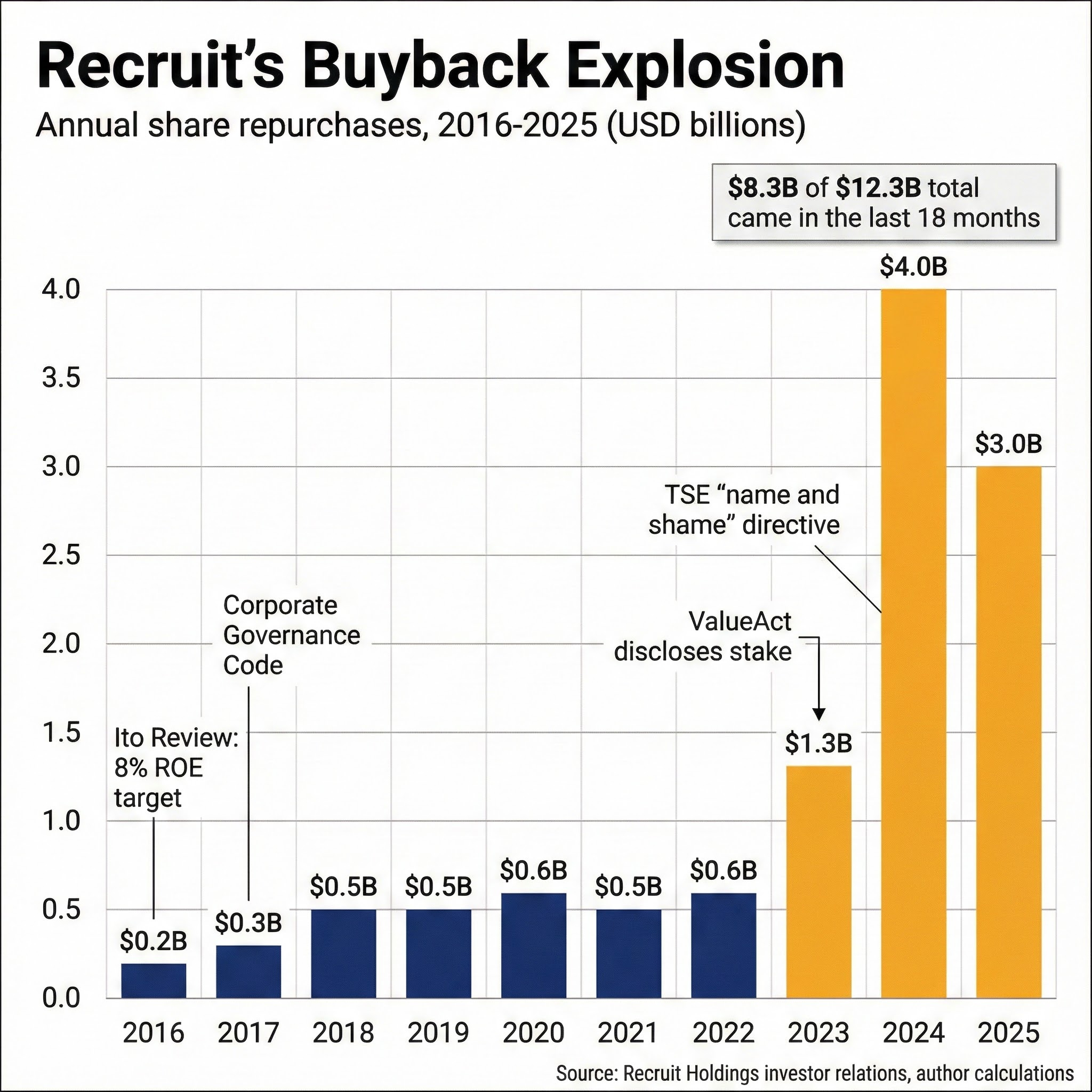
Recruit Holdings (started in the 1960s, and acquired Indeed.com in 2012) went public in October 2014, right as the governance reforms gained steam. Its first buyback came in 2016—a modest ¥30 billion ($200 million). Through 2022, total buybacks stayed relatively contained at around ¥400 billion ($2.7 billion) over six years. Disciplined, but not aggressive. However, the opportunity to improve shareholder returns in Japan had brought in investors like Warren Buffett5 and increasingly opened the door for activist investors.
Enter ValueAct Capital
Then ValueAct Capital, a US-based activist investor, took advantage of the changing Japanese market conditions.

In November 2023, the activist investor disclosed a 1.1% stake and declared Recruit “worth double its current share price”—partly because it was “undervalued due to its listing in Tokyo.”6
Within weeks, Recruit announced a ¥200 billion ($1.3 billion) buyback, its largest ever. By July 2024, that record was shattered with a ¥600 billion ($4 billion) program representing 5.67% of shares outstanding. February 2025 brought another ¥450 billion (~$3 billion).
In total, Recruit has returned over ¥1.87 trillion ($12.3 billion) in buybacks since 2016—with ¥1.25 trillion ($8.3 billion) of that concentrated in just the past 18 months. The company has canceled 132 million treasury shares. It now targets a ¥600 billion (~$4 billion) cash position and returns everything above that to shareholders.
The financial transformation shows in the numbers. ROE has climbed from 15% in 2021 to 22.6%—nearly three times the Ito Review’s minimum threshold.
Recruit has become exactly what Japanese governance reformers wanted: a disciplined, shareholder-focused capital allocator.
Where does all that cash come from?
Recruit Holdings’ Cash Cow: Indeed.com
The largest job search site in the world isn’t LinkedIn. It’s Indeed.com. And Indeed is owned by Recruit Holdings (this is why corporate governance reforms in Japan start to become important). Indeed, housed in Recruit’s HR Tech business unit, is the largest source of profits for the company.
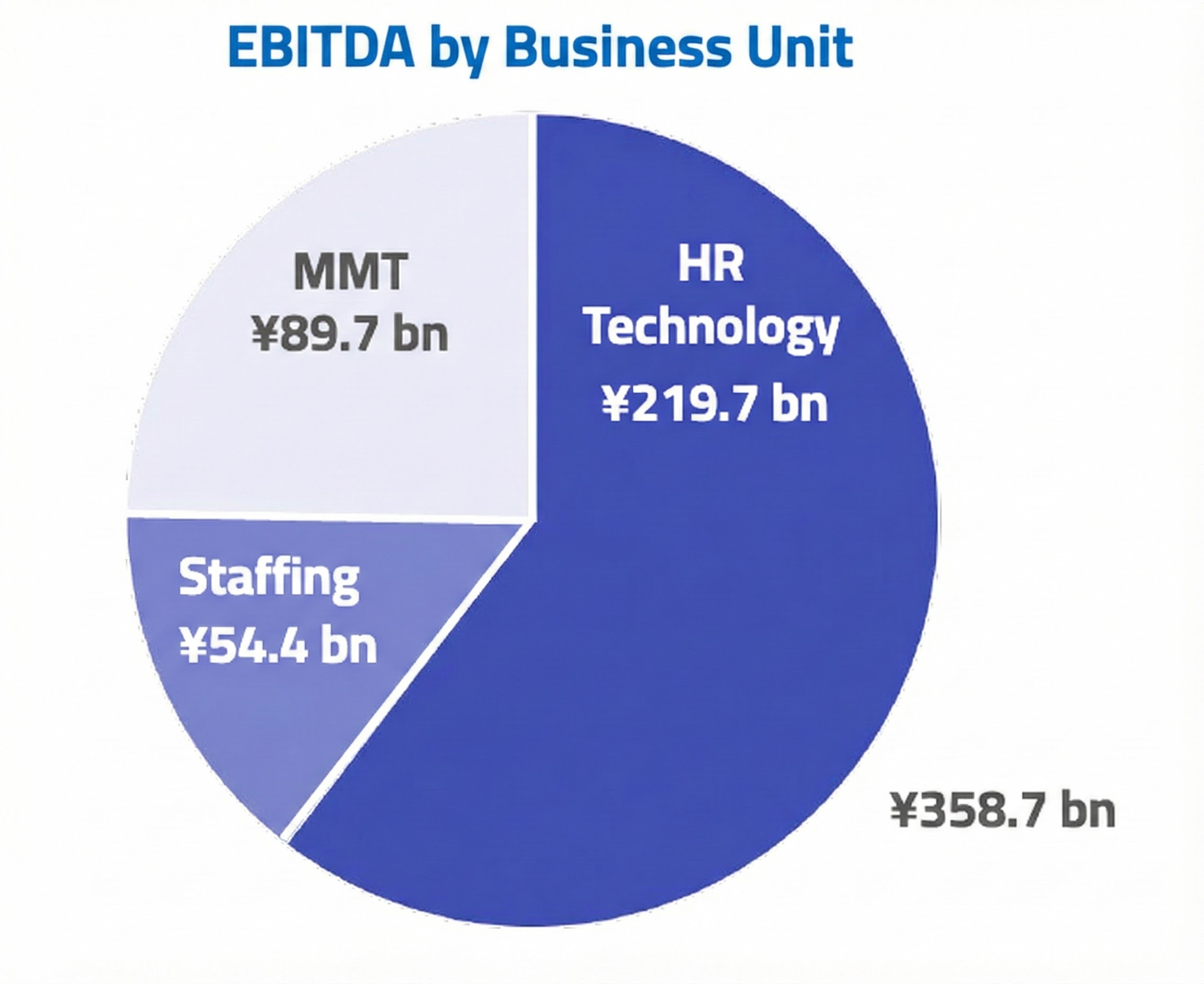
Indeed dominates the US job market in ways that are hard to overstate.
The platform commands roughly 390 million monthly visits globally, ranking #1 in “Jobs and Employment”7 . According to SilkRoad’s Sources of Hire studies, Indeed accounts for 65% of external hires in the US8—more than Monster, LinkedIn, and CareerBuilder combined.
In the non-knowledge-work market—hourly jobs, blue collar, service industry—Indeed’s dominance is even more pronounced. LinkedIn owns knowledge workers. Indeed owns almost everything else.
But traffic has been falling. Post-pandemic hiring has normalized, AI is disrupting traditional search, and the job market has softened. Meanwhile, competitors like ZipRecruiter and LinkedIn have been growing traffic (at Indeed’s expense)9.
For Recruit, facing pressure to generate large shareholder returns with a shrinking customer (employer) and user (job seeker) base, this creates a clear mandate: if volume is falling, revenue per unit must rise.
Which brings us to a new metric that Recruit introduced on its most recent earnings call.
The “Average Revenue Per Job” metric: or here come higher prices
On November 6, 202510, Recruit’s CFO unveiled a KPI called Average Revenue Per Job Post, or ARPJ.
The definition: US HR Technology revenue divided by the total number of jobs on Indeed—both free and paid, both directly posted and aggregated. The denominator includes all jobs.
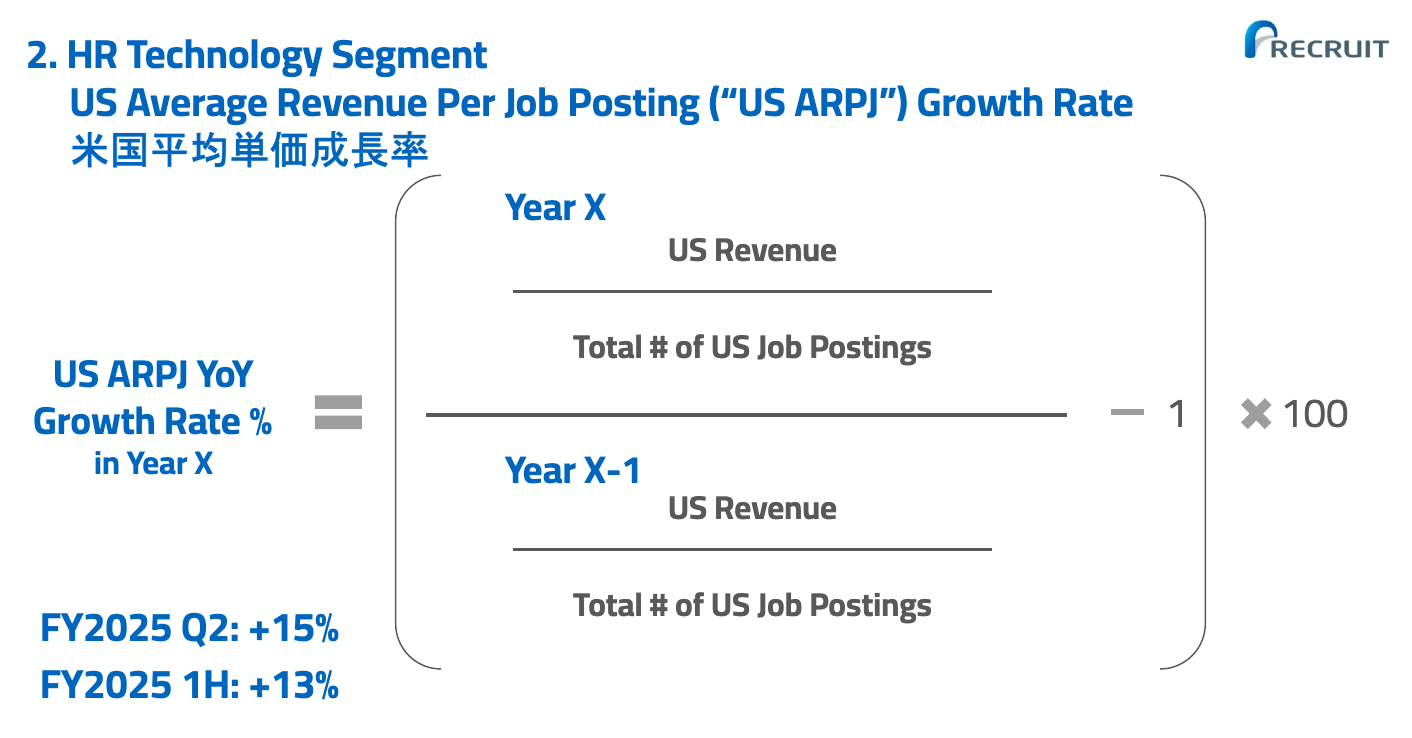
ARPJ measures monetization across the entire inventory, not just paying customers. And it’s easy to increase this metric without growing revenue. As long as the number of jobs on Indeed declines faster than revenue, ARPJ goes up. If fewer employers use Indeed, if fewer jobs end up on the platform—that’s not a problem for this KPI.
The numbers tell the story.
In Q2 FY2025, ARPJ grew 15% year-over-year while job postings declined 8%. Revenue still grew 5.8% despite the volume headwind. This decoupling of revenue from job volume has now persisted for six consecutive quarters, ever since the CEO announced the beginning of “Year Zero” in May 2024—a strategic pivot toward strengthening monetization during weak hiring demand.
Currently, paid jobs are a minority of total US postings on Indeed11. The runway for monetization is substantial. In October 2024, Indeed eliminated organic traffic for directly-posted jobs from employers who had indexed positions elsewhere12. If you want visibility, you sponsor.
Recruit expects ARPJ to grow another 16% in the second half of FY2025, offsetting a projected 7% decline in job postings. The math works even without a hiring recovery.
Indeed’s profit margin expansion
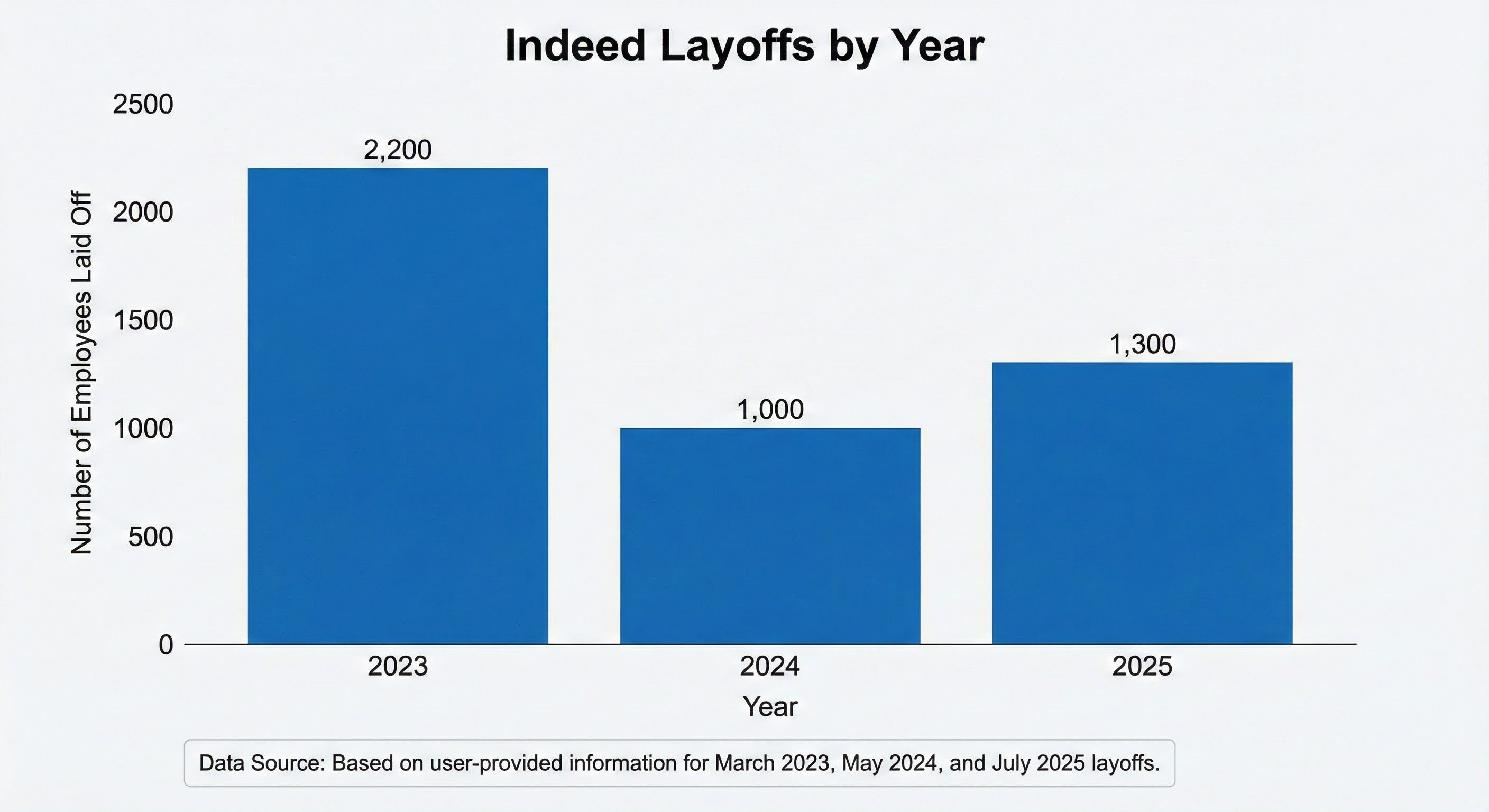
Indeed is also cutting costs aggressively. Three rounds of layoffs since 2023 have eliminated roughly 4,500 employees (or 30% of employees):
March 2023: ~2,200 employees (15% of workforce), citing “global slowdown in hiring.”
May 2024: ~1,000 employees (8%), for “organizational simplification.”
July 2025: ~1,300 employees (6% of HR Tech segment), driven by “AI-driven restructuring.”
The July 2025 round brought additional changes. Glassdoor was folded into Indeed. Glassdoor’s CEO departed. And Recruit’s CEO, Hisayuki “Deko” Idekoba, took direct control of Indeed operations in addition to running the parent company.
The margin impact is visible in the financials. HR Tech segment EBITDA margins have expanded from 28.1% to 34.7%—a 6.6 percentage point improvement in a year, driven largely by headcount reductions.
Higher prices. Fewer employees. Fatter margins. More cash flowing back to Tokyo.
Putting this all together
Japanese governance reforms created explicit pressure for ROE improvement and capital returns. ValueAct’s intervention catalyzed Recruit’s response. Funding those returns requires Indeed to generate more cash. ARPJ must rise, which means employers pay more. Headcount reductions improve margins. Product changes force monetization.
The CEO frames this as an opportunity, noting that Indeed’s “take rate”—cost per hire as a percentage of first-year salary—is only 1%, representing “significant opportunity to improve monetization.” Even without a hiring recovery, he told analysts, “through efforts, I think we can go on.”
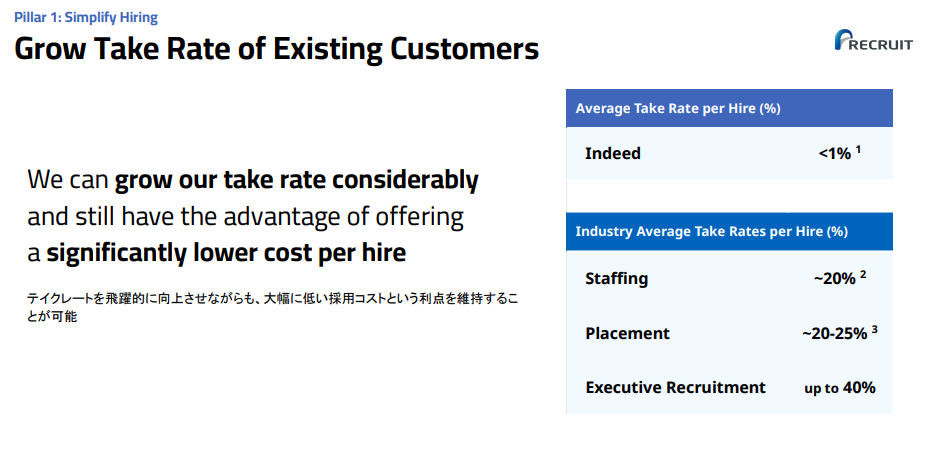
For employers, especially smaller ones who relied on Indeed’s historically free posting model, this is a fundamental shift. The platform that disrupted expensive job boards twenty years ago by offering free distribution is now becoming an expensive job board itself. And with Indeed controlling two-thirds of external hires—and an even larger share outside knowledge work—Indeed has strong pricing power.
The impact on the US hiring market
Higher employer costs could mean fewer postings, shorter listing durations, reduced visibility for smaller employers who can’t afford sponsorship. Job seekers searching for hourly work might find a thinner, more pay-to-play marketplace. The matching efficiency of the labor market—how quickly the right worker finds the right job—could quietly degrade in the US (remember, the ARPJ metric is focused on the US for now).
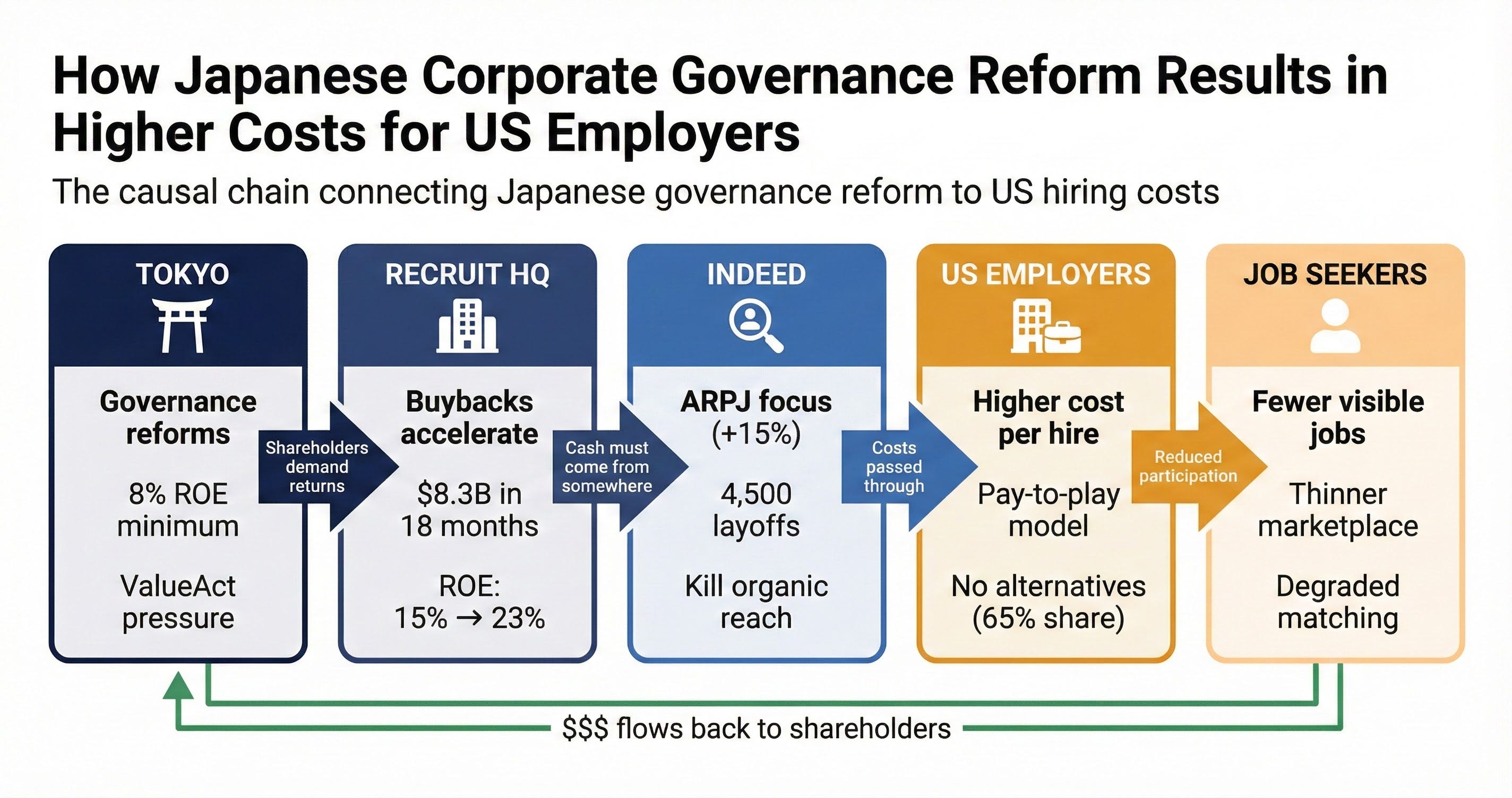
The Japanese governance revolution was designed to make corporations more accountable to shareholders. At Recruit, it worked. ROE nearly tripled. Buybacks accelerated. The stock responded.
The financing of that accountability could be paid by US businesses trying to hire—and transmitted through a job board to US job seekers who increasingly won’t see those listings unless they sponsor.
That’s how a push to improve Japanese corporate flows through to the US labor market.
https://www.indeed.com/lead/hiring-resources/why-indeed
https://recruit-holdings.com/en/ir/library/upload/recruit_202603Q2_presentation_en/
https://trends.google.com/trends/explore?date=today%205-y&geo=US&q=%2Fm%2F09ylwk&hl=en
https://www.meti.go.jp/policy/economy/keiei_innovation/kigyoukaikei/ito_review__released_august2014_en.pdf
https://www.wisdomtree.com/investments/blog/2025/03/18/buffett-loves-berkshires-japan-investments
https://www.reuters.com/markets/deals/valueact-takes-stakes-recruit-expedia-says-they-are-poised-strong-growth-2023-11-15/
https://www.similarweb.com/top-websites/category/jobs-and-career/jobs-and-employment/
https://www.indeed.com/news/releases/indeed-named-number-1-source-of-external-hires-for-4th-year
Based on ZipRecruiter and Microsoft earnings calls reporting growing traffic
https://recruit-holdings.com/files/ir/library/upload/Recruit_202603Q2_call-transcript_en.pdf
https://investorupdate-fy23.recruit-holdings.com/pdf/en/day1/investor_update_fy2023_day1_simplify_hiring_transcript_5_en.pdf
https://www.herbein.com/blog/fall-changes-ahead-employer-prepare-for-upcoming-changes-to-indeed-postings